Oct 24, 2026Product Sourcing Insights
How to Source Towels from China: Materials, GSM, Sizes, Wholesale & Private Label Guide
A practical B2B guide to sourcing towels from China, covering materials, GSM, towel types, customization, quality control, pricing and private label production.
Introduction
Sourcing towels from China may look straightforward until you begin comparing quotations.
Two suppliers may both quote a “100% cotton bath towel,” but the finished products can differ significantly in fabric weight, yarn quality, loop density, softness, absorbency, dimensions, color consistency, edge finishing and packaging.
The same issue applies to microfiber cleaning towels, face towels, hand towels and cooling sports towels.
For importers, wholesalers and private label brands, the most important question is therefore not simply:
“How much does this towel cost?”
A better question is:
“What exact towel specification am I comparing?”
This guide explains the main factors international buyers should understand when sourcing towels from China, including:
- Towel types and applications
- Common towel materials
- GSM and fabric weight
- Size selection
- Weaving and surface structures
- Custom colors and logos
- Private label packaging
- Sampling
- Quality control
- Pricing factors
- Supplier evaluation
SML Supply works with international buyers on China sourcing, supplier coordination, product development, quality control and export support. Based on our sourcing experience, clearly defining the specification before comparing suppliers is one of the most effective ways to reduce misunderstandings during a towel project.
1. What Types of Towels Can You Source from China?
“Towels” is a broad product category.
A buyer looking for an automotive cleaning cloth has very different requirements from a hotel sourcing bath towels or a sports brand developing cooling towels.
Before discussing materials or prices, the intended use should be defined first.
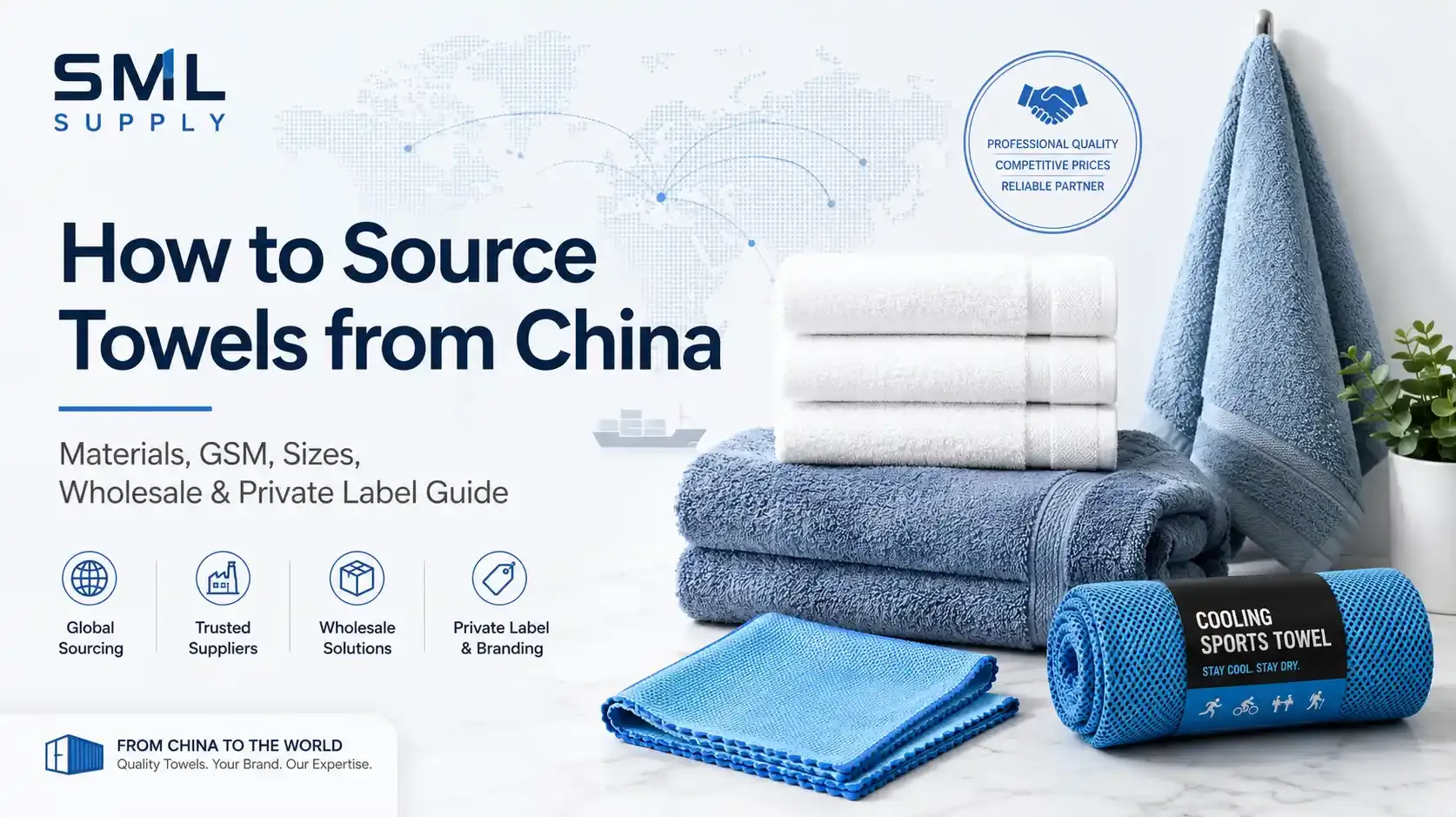
Face Towels
Face towels are mainly used for facial drying, personal care, bathroom use and daily hygiene.
Buyers normally pay particular attention to:
- Soft hand feel
- Water absorption
- Surface texture
- Fabric weight
- Skin-contact comfort
- Washing performance
- Color
- Size
Common materials include cotton, combed cotton, long staple cotton, bamboo viscose and cotton-blended constructions.
Bath Towels
Bath towels are larger products designed primarily for drying the body after bathing, showering, swimming or spa use.
Important sourcing factors include:
- Material
- GSM
- Dimensions
- Absorbency
- Softness
- Pile height
- Washing durability
- Color consistency
- Edge construction
Bath towels can be developed for household retail, hotels, spas, gyms and private label home textile collections.
Hanging Hand Towels
Hanging hand towels are designed with loops, straps, button structures or decorative hanging sections.
They are commonly used in:
- Kitchens
- Bathrooms
- Household retail
- Gift collections
- Homeware stores
Decorative styles may include bows, animals, characters, shaped designs and coordinated color collections.
For this category, see our custom hanging hand towels.
For smaller everyday or promotional formats, explore our custom hand towels and small towels for wholesale and private label programs.
Microfiber Cleaning Towels
Microfiber cleaning towels are designed for cleaning rather than personal drying.
Typical applications include:
- Household cleaning
- Kitchen cleaning
- Glass and mirror wiping
- Furniture
- Automotive interiors
- Car care
- Commercial cleaning
The buyer should consider fiber composition, density, surface structure, absorbency and lint performance according to the intended application.
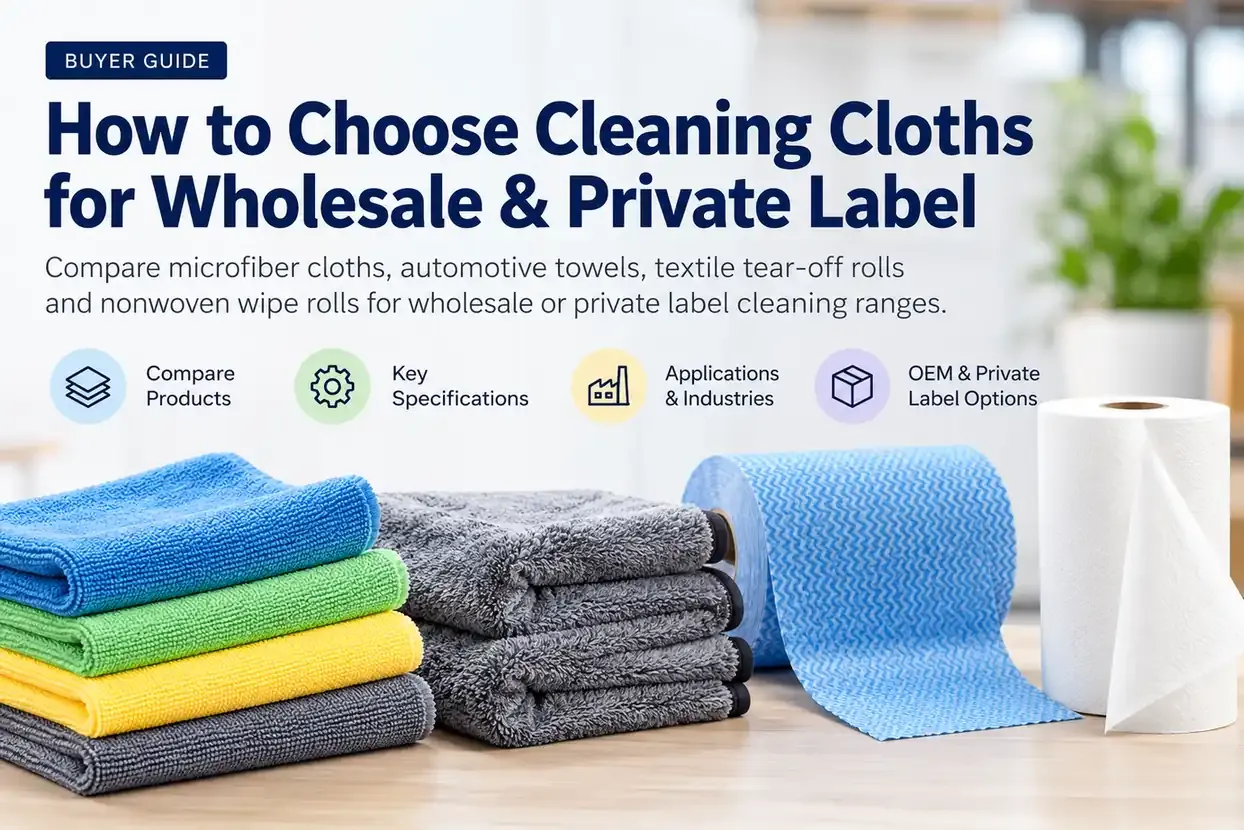
For buyers building a broader cleaning range, see our guide to choosing cleaning cloths for wholesale and private label.
Cooling Sports Towels
Cooling towels are lightweight sports textiles used for fitness, running, outdoor activities and hot-weather applications.
Depending on the product, materials may include:
- Microfiber
- Polyester
- Polyester-polyamide microfiber
- PVA
Water-activated cooling towels use moisture evaporation to create a cooling sensation.
Sports towel projects may also require portable bottles, canisters, carrying loops or individual retail packaging.
2. Common Towel Materials
Material is one of the first specifications buyers should confirm.
However, the fiber name alone does not determine the final towel quality.
100% Cotton
Cotton remains one of the most common materials for household and hospitality towels.
It is widely used for:
- Face towels
- Hand towels
- Bath towels
- Hotel towels
- Spa towels
Cotton towels can be produced at different quality and price levels depending on yarn, GSM, weaving construction and finishing.
Therefore, a quotation stating only “100% cotton” is not detailed enough for an accurate comparison.
Combed Cotton
Combed cotton undergoes additional fiber preparation to remove shorter fibers and improve fiber alignment.
It is commonly selected for towel collections where buyers want:
- A smoother appearance
- Softer hand feel
- More refined yarn
- Better product presentation
Combed cotton is often suitable for mid-range and premium household towel programs.
Long Staple Cotton
Long staple cotton can be used for higher-quality towel collections where yarn smoothness and softness are important.
However, buyers should avoid assuming that the cotton name alone guarantees a premium towel.
The final performance still depends on factors such as:
- Yarn quality
- GSM
- Loop construction
- Density
- Finishing
For private label sourcing, the complete towel specification should always be evaluated together.
Bamboo Viscose
Many products marketed commercially as “bamboo fiber towels” are made from bamboo-derived viscose.
Bamboo viscose is often chosen for its soft and smooth hand feel and moisture absorption.
It can be used for:
- Face towels
- Bath towels
- Personal care towels
- Gift towel sets
- Home textile collections
Buyers should confirm the actual fiber composition before determining product labels and packaging claims.
Bamboo Cotton Blends
Bamboo viscose and cotton can be blended in different proportions.
A blended construction may be used to balance:
- Softness
- Absorbency
- Fabric strength
- Washing performance
- Price
There is no universal blend ratio that is suitable for every product.
The composition should be selected according to the target market and required performance.
Microfiber
Microfiber is particularly important for cleaning and sports towel applications.
Compared with traditional terry cotton towels, microfiber products can be engineered for:
- Lightweight construction
- Moisture absorption
- Quick drying
- Cleaning performance
- Compact storage
Common microfiber constructions include polyester and polyester-polyamide options.
For cleaning applications, surface structure and density should be selected according to whether the cloth is intended for glass, automotive care, kitchens or general household cleaning.
Polyester
Polyester is commonly found in lightweight sports and promotional towels.
It can be suitable where buyers require:
- Lightweight products
- Quick drying
- Mesh structures
- Printing
- Bright colors
- Promotional applications
Certain polyester constructions are also suitable for sublimation printing.
PVA
PVA is used in some water-activated cooling towel products.
It has different moisture-retention and hand-feel characteristics compared with conventional microfiber towels.
Buyers developing cooling towel products should compare physical samples because microfiber and PVA products can feel and behave very differently.
3. Which Towel Material Should You Choose?
There is no single “best towel material.”
The correct choice depends on the application.
Application | Common Material Direction |
|---|---|
Face Towels | Cotton, Combed Cotton, Bamboo Viscose |
Bath Towels | Cotton, Combed Cotton, Long Staple Cotton, Bamboo Blends |
Hand Towels | Cotton, Bamboo Blends, Microfiber |
Cleaning Towels | Microfiber |
Automotive Cleaning | Microfiber |
Hotel Towels | Cotton and Cotton-Based Constructions |
Sports Towels | Microfiber, Polyester |
Cooling Towels | Microfiber, Polyester, PVA |
A sourcing project should therefore begin with the intended use rather than selecting a material only because it sounds more premium.
4. What Does GSM Mean for Towels?
One of the most important specifications in towel sourcing is GSM — grams per square meter.
GSM represents fabric weight per unit area.
It helps buyers compare how light or substantial different towel constructions are.
However:
Higher GSM does not automatically mean better quality.
Lower GSM Towels
Lighter constructions may offer:
- Lower product weight
- Faster drying
- Easier packing
- Lower transportation weight
- More economical pricing
These can be suitable for price-sensitive retail programs, sports products and certain commercial applications.
Medium GSM Towels
Medium-weight towels often provide a practical balance between:
- Absorbency
- Softness
- Drying speed
- Product weight
- Price
This makes them suitable for many everyday household applications.
Higher GSM Towels
Higher GSM constructions usually feel more substantial and can create a thicker or fuller product.
They may be suitable for:
- Premium household collections
- Hotels
- Spas
- Gift sets
- Higher-end private label products
But simply increasing GSM does not guarantee better performance.
GSM Should Not Be Evaluated Alone
When comparing towel samples, buyers should evaluate GSM together with:
- Fiber composition
- Yarn quality
- Loop density
- Pile height
- Fabric construction
- Finishing
- Absorbency
- Washing behavior
Two towels with similar GSM can still feel noticeably different.
5. How to Choose Towel Sizes
Towel dimensions vary by product category, market and customer preference.
Instead of relying only on names such as “face towel” or “bath towel,” buyers should specify:
Width × Length
during quotation.
Common Towel Size Categories
A product range may include:
Face Cloths
Small products for facial cleansing and personal care.
Face Towels
Longer everyday towels for facial or hand drying.
Hand Towels
Designed for bathrooms, kitchens or hospitality use.
Bath Towels
Larger towels designed for drying the body.
Oversized Bath Towels
Larger formats for premium home textile or hospitality applications.
Sports Towels
Compact or longer lightweight towels designed for gym and outdoor use.
Cleaning Cloths
Usually smaller formats designed for surface wiping and cleaning.
Because market definitions vary, exact dimensions should always be included in your RFQ.
6. Understanding Towel Construction
Material and GSM are only part of the specification.
Different textile structures create very different towel products.
Terry Towels
Terry construction uses loops on the fabric surface and is common for:
- Face towels
- Hand towels
- Bath towels
- Hotel towels
Loop structure plays an important role in softness and moisture absorption.
Jacquard Towels
Jacquard weaving creates patterns within the fabric construction.
It can be used for:
- Decorative designs
- Brand patterns
- Geometric patterns
- Logo development
- Sports towels
- Premium retail products
Jacquard construction is useful when a buyer wants product differentiation without relying only on printing.
Woven or Dobby Borders
Decorative woven borders are commonly used on bath towels and hand towels.
Buyers can customize:
- Border width
- Pattern
- Color
- Logo
- Yarn combination
Embroidered Towels
Embroidery is widely used for:
- Hotel logos
- Brand logos
- Initials
- Decorative motifs
- Promotional products
When requesting embroidery, buyers should consider logo dimensions and complexity rather than simply requesting “custom logo.”
Printed Towels
Printing can be used for decorative designs and promotional applications.
The suitable printing method depends on the towel material and surface structure.
Mesh and Lightweight Structures
Mesh structures are commonly found in sports and cooling towels.
They can support lightweight construction and increased exposure of wet fabric to airflow.
7. Custom Colors for Towel Production
Color is another important part of private label towel development.
Buyers can choose between:
- Existing supplier colors
- Standard production colors
- Custom dyed colors
Custom color development may require higher order quantities than selecting existing colors.
For custom colors, buyers should provide a clear reference such as:
- Pantone reference
- Physical fabric swatch
- Existing towel sample
- Approved color standard
Color approval should be completed before bulk production whenever color consistency is important.
8. Custom Logo Options for Towels
Different towel products require different branding methods.
Common options include:
Embroidery
Suitable for many cotton bath towels, hand towels and hospitality products.
Jacquard Logo
The logo or pattern becomes part of the woven towel structure.
This can create a more integrated branded appearance.
Woven Labels
A woven brand label can be sewn into the towel edge or seam.
Printed Labels
Suitable for care information, brand information and product labeling.
Printing
Certain sports and promotional towels can support surface printing.
Sublimation
Suitable for compatible polyester constructions where full-color graphics are required.
The logo method should be selected according to the fabric rather than choosing one process for every towel.
For buyers developing a completely customized towel rather than purchasing a standard existing style, our product development service can help coordinate specifications, sampling and customization.
9. Private Label Towel Packaging
Packaging can significantly affect both product cost and retail positioning.
Common B2B towel packaging options include:
- Individual polybag
- Multiple-piece polybag
- Paper sleeve
- Belly band
- Hangtag
- Printed box
- Gift box
- Retail display packaging
- Reusable bottle or canister for cooling towels
- Custom private label packaging
Additional requirements may include:
- Barcode labels
- Care labels
- Fiber composition labels
- Country-specific product information
- Carton markings
- Retail stickers
Buyers should include packaging requirements in the initial quotation request rather than waiting until production is ready.
10. How to Develop a Private Label Towel
A typical private label towel development process can follow these steps.
Step 1: Define the Product Type
Start with the application:
- Face towel
- Bath towel
- Hand towel
- Cleaning towel
- Sports towel
- Cooling towel
Step 2: Select the Material
Confirm the required fiber composition and market positioning.
Step 3: Confirm Size and GSM
Provide dimensions and required fabric weight.
Step 4: Select Construction
Decide between terry, jacquard, microfiber, mesh or another suitable construction.
Step 5: Select Color
Choose existing colors or request custom color development.
Step 6: Add Branding
Confirm:
- Logo method
- Brand label
- Care label
- Hangtag
Step 7: Develop Packaging
Determine whether the product will be sold individually, in a set or in customized retail packaging.
Step 8: Produce Samples
A physical sample allows the buyer to evaluate the complete product before bulk production.
Step 9: Approve the Final Specification
The approved sample and specification should become the reference for mass production.
Step 10: Bulk Production and Inspection
Production should be checked against agreed specifications before shipment.
11. What Should You Check on a Towel Sample?
A towel sample should not be approved based only on appearance.
Buyers should evaluate several factors.
Material and Hand Feel
Does the product match the expected fiber composition and softness?
Dimensions
Measure the width and length instead of relying only on the supplier's description.
Fabric Weight
Confirm that the product is consistent with the agreed weight or GSM requirement.
Absorbency
Check whether the towel performs appropriately for its intended use.
A cleaning towel, bath towel and cooling towel should not be evaluated using exactly the same criteria.
Color
Compare samples against the approved reference under suitable lighting conditions.
Sewing and Edges
Check:
- Uneven stitching
- Loose threads
- Edge distortion
- Open seams
- Poor corner finishing
Loops and Surface
For terry towels, check the overall loop condition and obvious pulled loops.
Logo
Verify:
- Position
- Size
- Orientation
- Color
- Embroidery or printing quality
Packaging
Make sure:
- The correct product is packed
- Labels are accurate
- Barcodes are correct
- Packaging matches the approved design
12. Towel Quality Control Before Shipment
Bulk inspection is especially important when the buyer has customized material, color, logo or packaging.
Depending on the project, a towel inspection may include:
- Product quantity
- Size
- Product weight
- Fabric appearance
- Color consistency
- Sewing
- Loose threads
- Surface defects
- Logo position
- Embroidery
- Labels
- Packaging
- Carton markings
Additional laboratory or performance testing can be arranged when required by the buyer or target market.
For customized orders, the approved sample is especially valuable because it provides a physical reference for production and inspection.
13. What Affects the Price of Towels?
Towel quotations can differ substantially even when the product photographs appear similar.
The main pricing factors generally include:
Material
Different fibers and yarn grades have different costs.
GSM
Increasing fabric weight generally increases material consumption.
Size
Larger towels require more fabric.
Yarn and Construction
Different yarn specifications, loop structures and weaving methods affect production cost.
Color
Stock colors and customized dyeing can have different requirements.
Design
Jacquard patterns, special borders and complex constructions may require additional development.
Logo
Embroidery, jacquard and printing have different cost structures.
Packaging
A simple polybag and a custom printed retail gift box should not be compared as the same product.
Order Quantity
Quantity affects production efficiency, customization feasibility and unit cost.
14. Why the Cheapest Towel Quote May Not Be the Cheapest Product
One of the most common problems in towel sourcing is comparing quotations that are not based on the same specification.
For example:
Supplier A
- 100% cotton
- Smaller size
- Lower GSM
- Simple packaging
Supplier B
- 100% cotton
- Larger size
- Higher GSM
- Custom label
- Retail packaging
Both quotations may simply say:
Cotton Bath Towel
but they are not equivalent products.
Before selecting a supplier, buyers should create a specification sheet containing at least:
- Material
- Size
- GSM or weight
- Color
- Construction
- Logo
- Label
- Packaging
- Quantity
Only then does the price comparison become meaningful.
15. How to Request a Towel Quotation from China
A clear RFQ can significantly improve quotation accuracy.
Provide as much of the following information as possible:
- Towel type
- Material
- Fiber composition
- Dimensions
- GSM
- Quantity
- Colors
- Logo
- Design
- Label requirements
- Packaging
- Destination country
If you do not know all the specifications, provide:
- Reference photos
- Existing samples
- Intended use
- Target customer
- Required quality level
- Target price positioning
A sourcing company or experienced supplier can then help narrow down suitable options.
16. How to Compare Towel Suppliers
Do not compare suppliers only by quotation.
A practical supplier evaluation should consider:
Product Capability
Can the supplier make the required material, GSM, construction and design?
Sample Quality
Does the physical sample match the specification?
Customization Capability
Can the supplier support your required:
- Logo
- Labels
- Colors
- Packaging
- Custom dimensions
Communication
Does the supplier clearly understand the specification and respond accurately?
Quality Control
Can production be checked against an approved standard?
Repeatability
For long-term wholesale programs, consistency between orders may be more important than obtaining the lowest price on the first order.
SML Supply maintains a broader sourcing and supplier network for international buyers. You can learn more about our supplier network.
17. Should You Work with One Towel Factory or Multiple Suppliers?
This depends on the product range.
A factory specializing in cotton bath towels may not necessarily be the strongest supplier for:
- Microfiber cleaning cloths
- PVA cooling towels
- Decorative hanging towels
- Promotional sports towels
If your collection includes several towel categories, sourcing from specialized suppliers can sometimes provide better product matching.
However, managing multiple factories also creates additional work involving:
- Communication
- Sampling
- Quality standards
- Packing
- Consolidation
- Shipping
This is where a sourcing partner can help coordinate multiple product categories under one purchasing project.
18. Common Mistakes When Sourcing Towels
Comparing Only the Unit Price
A lower price may simply mean a different GSM, size or construction.
Specifying Only the Material
“100% cotton” is not a complete towel specification.
Ignoring GSM
Fabric weight has a major influence on product positioning and cost.
Approving Color from a Screen Only
Digital colors can appear different across monitors and devices.
Developing Packaging Too Late
Retail packaging should be considered early because it affects cost, MOQ and carton planning.
Skipping the Final Sample
For customized projects, approving the actual product before mass production reduces uncertainty.
Assuming One Supplier Is Best for Every Towel
Different factories may specialize in different textile constructions.
19. How SML Supply Supports Towel Sourcing Projects
SML Supply is a B2B China sourcing and export service provider working with international importers, wholesalers and private label brands.
For towel projects, our role can include:
- Product sourcing
- Supplier comparison
- Specification development
- Material selection
- Sample coordination
- Custom logo development
- Private label packaging
- Quality control
- Supplier communication
- Export coordination
We are not limited to the towel products displayed on our website.
The online products serve as reference examples of available categories and sourcing capabilities. If your required towel is not shown, you can send us a photograph, specification sheet or existing sample for evaluation.
20. Building a Complete Towel Collection
For importers and home textile brands, it is often more efficient to think in terms of a collection rather than a single SKU.
For example, one project could include:
- Face towels
- Hand towels
- Bath towels
using coordinated:
- Materials
- Colors
- Borders
- Logos
- Packaging
Another buyer may develop:
- Microfiber cleaning towels
- Automotive cloths
- Kitchen cleaning cloths
under one cleaning product brand.
A sports company may combine:
- Gym towels
- Cooling towels
- Portable storage containers
- Custom branding
The sourcing strategy should reflect the final sales channel and customer rather than treating every towel as an isolated product.
21. Final Checklist Before Placing a Towel Order
Before confirming production, make sure the following items are clearly defined:
- Product type
- Material
- Fiber composition
- Size
- GSM or product weight
- Color
- Fabric construction
- Logo
- Label
- Packaging
- Quantity
- Approved sample
- Quality requirements
- Shipping destination
The more clearly these points are confirmed before production, the easier it becomes to compare quotations and manage quality consistently.
Source Towels from China with SML Supply
Whether you are sourcing cotton bath towels, bamboo viscose face towels, microfiber cleaning towels, hanging hand towels or cooling sports towels, the best sourcing result usually starts with a clear product specification.
SML Supply helps international B2B buyers identify suitable suppliers, develop customized specifications, coordinate samples, manage quality control and arrange export support from China.
If you already have product specifications, reference images or existing samples, send them to us for evaluation.
If you are still deciding between materials, GSM, sizes or manufacturing options, we can also help compare suitable sourcing directions according to your target market and budget.
About the Author
Author: Connor Ma, Founder of SML Supply
Connor Ma works with international B2B buyers on China sourcing, supplier coordination, product development and export projects. This guide is written from a practical sourcing perspective to help buyers define towel specifications more clearly before requesting quotations and starting production.
Published by: SML Supply
SML Supply provides China sourcing, supplier coordination, product development, quality control and export support for international B2B buyers.