
Oct 24, 2026Wholesale Buying Guide
How Much Should You Order from a Chinese Supplier? A Practical Guide for Wholesale Buyers
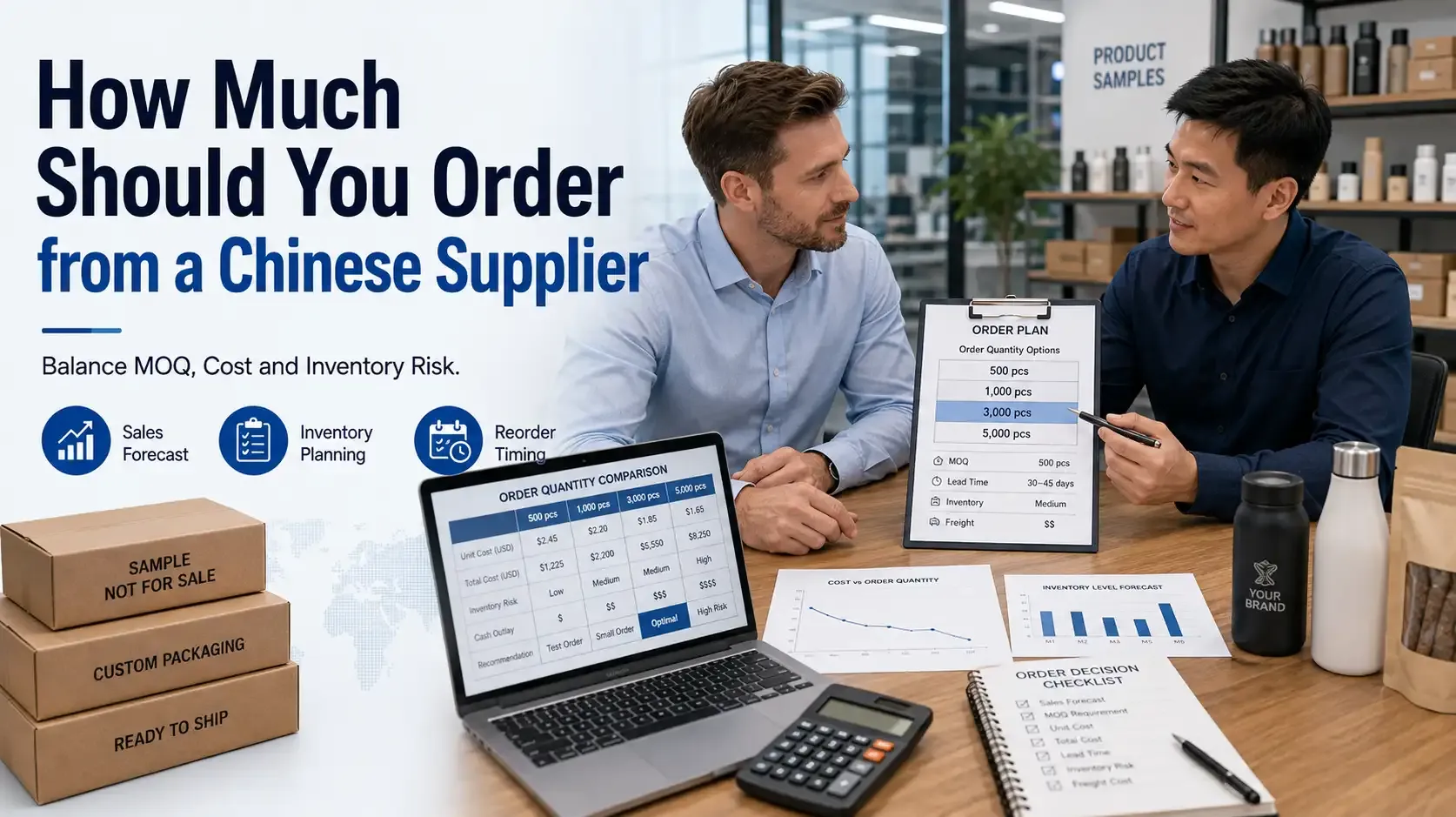
Learn how to choose the right order quantity from Chinese suppliers by balancing MOQ, unit price, inventory risk, freight costs, and expected sales.
Author: Connor Ma, Founder of SML Supply
Published by: SML Supply
Deciding how much to order from a Chinese supplier is one of the most important purchasing decisions for a wholesale buyer.
Ordering too little can result in a higher unit price, inefficient freight costs, and frequent reordering.
Ordering too much can tie up cash, increase warehouse costs, and leave the buyer with slow-moving inventory.
The right quantity is therefore not simply the supplier's minimum order quantity.
It should be based on a balance between:
- expected sales
- MOQ
- unit price
- freight cost
- inventory risk
- cash flow
- lead time
- seasonality
- product life cycle
- reorder frequency
For many buyers, especially those sourcing a new product or entering a new market, choosing the right order quantity is more important than getting the lowest possible unit price.
This guide explains how to calculate a practical purchasing quantity when buying wholesale from Chinese suppliers.
MOQ Is Not the Same as the Right Order Quantity
MOQ stands for Minimum Order Quantity.
It tells you the smallest quantity a supplier is normally willing to manufacture or sell under a particular set of conditions.
But MOQ does not tell you how much you should actually buy.
For example, a supplier may have an MOQ of 500 pieces.
That does not automatically mean:
500 pieces is the correct quantity for your business.
You may decide that:
- 500 pieces is too risky for a new product
- 1,000 pieces gives a much better price
- 2,000 pieces reduces freight cost per unit
- 3,000 pieces matches six months of expected sales
The supplier's MOQ is therefore only the starting point.
If the supplier's minimum quantity is higher than you can reasonably sell, first review our guide on how to negotiate MOQ with Chinese suppliers.
Start With Expected Sales
The first question should not be:
“What quantity gives me the lowest price?”
It should be:
“How many units can I realistically sell?”
This sounds simple, but buyers frequently reverse the process.
They see that the supplier offers a better price at 5,000 pieces and then try to justify purchasing 5,000 pieces.
A safer approach is to estimate demand first and then evaluate which supplier quantity tier makes sense.
Existing Products
If you already sell the product, use actual sales data.
For example:
- average monthly sales: 400 units
- supplier lead time: 45 days
- shipping and receiving time: 30 days
- desired safety stock: 300 units
You can use these numbers to estimate how much inventory is needed before the next shipment arrives.
Historical data makes purchasing decisions much easier.
New Products
New products are more difficult because there is no reliable sales history.
In this situation, buyers should be more conservative.
Consider:
- demand for similar products
- expected selling price
- customer feedback
- preorders
- competitor sales activity
- marketplace demand
- seasonal trends
- marketing budget
- sales channels
The objective of a first order should usually be to gather real market information without creating excessive inventory exposure.
Trial Orders Can Reduce Risk
For an untested product, the first order is often better treated as a trial order.
A trial order allows you to evaluate:
- customer demand
- product quality
- packaging
- supplier performance
- defect rates
- shipping process
- customer feedback
- actual selling price
- reorder potential
Suppose a supplier offers:
- 500 pcs at $3.50
- 1,000 pcs at $3.10
- 3,000 pcs at $2.70
The 3,000-piece price looks attractive.
However, if the product has never been tested in your market, purchasing 3,000 units simply to save $0.80 per piece may create unnecessary risk.
Paying a slightly higher unit price for the first 500 or 1,000 units may be more economical if it prevents thousands of dollars in unsold inventory.
Understand Quantity-Based Pricing
Chinese suppliers commonly quote different prices at different quantities.
For example:
Quantity | Unit Price |
|---|---|
500 pcs | $4.20 |
1,000 pcs | $3.85 |
3,000 pcs | $3.55 |
5,000 pcs | $3.45 |
At first glance, purchasing 5,000 pieces appears to be the best deal.
But the important question is:
How much additional money must you invest to obtain the lower price?
Moving from 1,000 pieces at $3.85 to 5,000 pieces at $3.45 saves $0.40 per unit.
But it also requires purchasing another 4,000 pieces.
The total additional inventory commitment is much more important than the $0.40 saving.
Before increasing an order, calculate both:
unit price saving
and
additional inventory investment.
If you want to understand how to negotiate these price tiers with suppliers, see our guide on how to negotiate wholesale prices with Chinese suppliers.
Do Not Buy More Just to Get a Lower Unit Price
This is one of the most common mistakes in wholesale purchasing.
A lower unit price does not automatically mean a lower total business cost.
Imagine two options:
Option A
1,000 pcs × $5.00 = $5,000
Option B
3,000 pcs × $4.50 = $13,500
Option B saves $0.50 per unit.
But it requires an additional $8,500 in inventory.
If you cannot sell the extra 2,000 units quickly, that capital remains tied up in stock.
You may also incur:
- storage costs
- insurance
- damaged inventory
- markdowns
- obsolete stock
- financing costs
The lowest unit price is therefore not always the lowest-risk purchasing decision.
Calculate Your Inventory Coverage
A useful way to evaluate order quantity is to calculate how many months of sales the order represents.
For example:
Expected monthly sales: 500 units
Proposed order: 3,000 units
Inventory coverage:
3,000 ÷ 500 = 6 months
This means the order represents approximately six months of expected sales.
Whether that is appropriate depends on the product.
For a stable, proven product, six months may be reasonable.
For a fashion item, seasonal product, trend-driven product, or newly launched product, six months may create unnecessary risk.
Consider Supplier Lead Time
Order quantity should also reflect how long it takes to replenish inventory.
A sourcing timeline may include:
- order confirmation
- material purchasing
- production
- quality inspection
- domestic transportation
- export preparation
- international freight
- customs clearance
- final delivery
If this entire process takes two or three months, buyers need enough inventory to continue selling while the next order is being produced and shipped.
Short replenishment cycles allow smaller orders.
Long replenishment cycles may require larger inventory buffers.
Keep Safety Stock
A buyer should rarely plan inventory so tightly that stock reaches zero exactly when the next shipment arrives.
Unexpected delays can happen.
Examples include:
- production delays
- material shortages
- inspection issues
- port congestion
- customs delays
- shipping schedule changes
- unexpectedly strong sales
Safety stock provides a buffer.
For example:
Average monthly sales: 1,000 pcs
Expected replenishment period: 2 months
Basic requirement:
2,000 pcs
If you want one additional month of safety stock:
2,000 + 1,000 = 3,000 pcs
This does not mean every business needs one month of safety stock.
The appropriate amount depends on the product, supplier reliability, shipping method, and sales volatility.
Consider Cash Flow
Inventory consumes cash before it generates revenue.
When purchasing from China, buyers may need to pay:
- deposit
- production balance
- packaging costs
- inspection
- freight
- import duties
- customs charges
- destination delivery
Some of these costs occur weeks or months before the products are sold.
Therefore, the order quantity must fit the company's cash-flow capacity.
A business may be able to afford 10,000 units technically, but that does not necessarily mean investing that much capital in one product is a good decision.
Cash tied up in excess inventory cannot easily be used for:
- marketing
- new products
- salaries
- operations
- additional purchasing
- unexpected expenses
Healthy purchasing decisions preserve enough working capital for the rest of the business.
Think About Product Risk
Not all products have the same inventory risk.
Low-Risk Products
Examples may include products with:
- stable demand
- long shelf life
- low fashion sensitivity
- repeat customers
- proven sales history
These products may justify larger orders.
Higher-Risk Products
Higher-risk inventory may include:
- fashion items
- seasonal products
- trend products
- products with rapidly changing technology
- licensed designs
- holiday packaging
- products with short expiration periods
- newly launched products
These products generally require more conservative purchasing.
A Christmas-themed gift bag, for example, has a very different inventory risk from a basic household towel.
If seasonal goods arrive too late or remain unsold after the season, the remaining inventory may lose much of its commercial value.
Account for Product Variants
Total order quantity can become misleading when a product has many colors, sizes, or designs.
Suppose you order:
3,000 pieces total
That sounds like a reasonable quantity.
But if the product includes:
- 5 colors
- 6 sizes
you potentially have 30 SKU combinations.
3,000 pieces divided by 30 combinations equals only:
100 pieces per SKU
Some combinations may sell quickly while others barely move.
When evaluating order size, buyers should therefore consider both:
total units
and
units per SKU.
This is especially important for apparel, footwear, accessories, colors, designs, and product collections.
Reduce SKU Complexity for the First Order
For a first order, fewer variants can make inventory management much easier.
Instead of ordering:
- 8 colors
- 5 designs
- 4 packaging options
consider starting with the strongest combinations.
This provides several advantages:
- lower inventory risk
- more units per SKU
- simpler quality control
- easier warehouse management
- clearer sales data
- easier reordering
Once the best-selling combinations become clear, future orders can expand the assortment.
Consider Seasonality
Seasonal products require careful timing.
Examples include:
- Christmas products
- Halloween products
- summer products
- winter accessories
- back-to-school products
- promotional event products
For these goods, the issue is not simply how many units can eventually be sold.
The question is how many can be sold before the selling season ends.
A buyer ordering too late or too much may be forced to carry inventory until the following year.
That can create:
- storage costs
- damaged packaging
- outdated designs
- reduced cash flow
- discounting
Seasonal order quantities should therefore be planned based on the actual selling window.
Freight Cost Can Affect Order Quantity
Very small orders can be inefficient to ship internationally.
For example, some logistics costs are relatively fixed regardless of whether the shipment contains 100 or 300 units.
This can make freight cost per unit very high for small shipments.
As quantity increases, shipping efficiency may improve.
However, buyers should not increase inventory dramatically just to reduce freight cost per unit.
The correct approach is to compare the total cost at several order quantities.
To compare product cost, freight, duties and other import expenses together, see our guide on how to calculate landed cost when buying wholesale from China.
For example:
500 Units
Product cost: higher
Freight per unit: higher
Inventory risk: lower
2,000 Units
Product cost: lower
Freight per unit: lower
Inventory risk: higher
The best choice depends on the overall commercial result, not one cost component.
Packaging Can Change Order Economics
Custom packaging often has its own MOQ.
For example:
Product MOQ: 500 pcs
Custom box MOQ: 2,000 pcs
If you order only 500 products, you may still need to purchase 2,000 boxes.
That creates 1,500 unused boxes.
Sometimes this is acceptable if future orders will use exactly the same packaging.
But if the branding, product specifications, barcode, regulatory information, or design changes, those remaining boxes may become unusable.
For smaller first orders, standard packaging with simple branding can sometimes reduce this risk.
Calculate the Cost of Unsold Inventory
Buyers often calculate the cost of purchasing inventory but forget to calculate the risk of not selling it.
Suppose:
Unit landed inventory value: $8
Unsold quantity: 1,000 pcs
Potential capital tied up:
$8,000
If the products later require a 30% discount to sell, the apparent saving achieved through a larger order may disappear quickly.
This is why inventory risk should be treated as a real cost.
Consider Reorder Frequency
Another important question is:
How often are you willing to reorder?
Smaller, more frequent orders have advantages:
- lower inventory exposure
- faster response to sales trends
- easier design changes
- less cash tied up
- easier product updates
But they can also create:
- higher unit prices
- more purchase orders
- more freight arrangements
- more inspections
- more administrative work
Larger, less frequent orders reduce operational frequency but increase inventory exposure.
There is no universal answer.
The right balance depends on your sales volume, supplier lead time, team capacity, freight structure, and cash flow.
First Order vs Repeat Order
Your first order and repeat orders should not necessarily be the same size.
First Order
The first order is primarily about learning.
You are evaluating:
- product demand
- supplier quality
- packaging
- shipping
- customer reaction
- actual selling price
A conservative quantity may therefore be appropriate.
Second Order
The second order can use actual information from the first order.
You know:
- monthly sales
- best-selling SKUs
- defect rate
- lead time
- supplier performance
You can increase quantity more confidently.
Mature Repeat Orders
Once demand is stable, larger production runs can be used to improve unit price and freight efficiency.
In this way, purchasing quantity can increase progressively as uncertainty decreases.
A Practical Order Quantity Example
Imagine a retailer is sourcing a new household product from China.
The supplier offers:
- MOQ: 500 pcs
- 500 pcs: $4.50
- 1,000 pcs: $4.10
- 3,000 pcs: $3.70
The buyer expects to sell approximately 300 units per month.
Option 1: 500 Pieces
Inventory coverage:
About 1.7 months
Advantages:
- low inventory risk
- limited cash exposure
- suitable for market testing
Disadvantages:
- highest unit price
- may require quick reorder
Option 2: 1,000 Pieces
Inventory coverage:
About 3.3 months
Advantages:
- better unit price
- reasonable inventory coverage
- lower reorder frequency
Disadvantages:
- more capital invested
Option 3: 3,000 Pieces
Inventory coverage:
About 10 months
Advantages:
- lowest unit price
- fewer reorders
Disadvantages:
- significant inventory exposure
- substantial cash commitment
- high risk if demand is weaker than expected
For a new product, 1,000 pieces may provide a better balance than automatically choosing the cheapest 3,000-piece price.
The exact decision still depends on freight, cash flow, seasonality, and confidence in the sales forecast.
Ask Suppliers for Multiple Quantity Quotes
Instead of asking only:
“What is your price?”
ask for several quantity levels.
For example:
Please quote your price for 500 pcs, 1,000 pcs, 3,000 pcs, and 5,000 pcs.
This allows buyers to see the supplier's pricing curve.
You may discover that:
- 500 to 1,000 pcs creates a large price reduction
- 1,000 to 3,000 pcs creates a moderate reduction
- 3,000 to 5,000 pcs creates almost no meaningful reduction
In that case, increasing from 3,000 to 5,000 units may not justify the additional inventory investment.
Ask Whether Different Products Can Be Consolidated
Some buyers source several product categories from China at the same time.
They may purchase:
- towels
- bottles
- gift bags
- toys
- household goods
- promotional items
Each supplier may have a relatively small order.
Although production MOQs remain supplier-specific, combining several completed orders into a coordinated sourcing and export process can sometimes improve overall purchasing efficiency.
This can be particularly useful for importers and retailers purchasing multiple categories rather than one large-volume product.
If your purchasing plan involves several different product types and suppliers, read our guide on how to buy multiple product categories from China.
SML Supply works through its Supplier Network to support multi-supplier and multi-category sourcing projects.
Quality Control Should Affect Order Size
A buyer should also consider supplier reliability before placing a large order.
If this is your first transaction with a new supplier, placing an extremely large order before evaluating production quality increases risk.
A smaller first production run allows you to evaluate:
- workmanship
- material consistency
- packaging quality
- production accuracy
- communication
- delivery performance
Before shipment, products should be checked against approved specifications.
Once a supplier has demonstrated consistent performance, larger repeat orders may become more appropriate.
Do Not Ignore Warehouse Capacity
Order quantity must also match your ability to receive and store the goods.
Before ordering, consider:
- number of cartons
- carton dimensions
- total cubic volume
- pallet requirements
- warehouse space
- handling costs
A product may look small individually but occupy substantial space when thousands of units are packed into cartons.
If you use a third-party fulfillment warehouse, storage fees may also increase as inventory remains unsold.
Warehouse economics should therefore be considered before increasing purchase quantities.
Watch for Changes in the Product
Larger inventory quantities increase risk when products change frequently.
Changes may include:
- packaging redesign
- updated logo
- new barcode
- regulatory labeling
- product improvements
- new colors
- revised dimensions
- updated electronics
- new market requirements
If you hold one year of inventory, you have much less flexibility to introduce changes.
Smaller purchasing cycles make it easier to update the product.
How to Decide Your First Order Quantity
For a new product, use a structured process.
Step 1: Check the Supplier MOQ
Understand whether it applies per product, color, size, or design.
Step 2: Estimate Monthly Sales
Use market data, similar products, customer demand, or existing sales history.
Step 3: Calculate Inventory Coverage
Determine how many months of inventory each proposed quantity represents.
Step 4: Compare Quantity Prices
Request several price tiers from the supplier.
Step 5: Estimate Replenishment Time
Include production and shipping time.
Step 6: Add Appropriate Safety Stock
Allow for unexpected delays or stronger sales.
Step 7: Evaluate Cash Flow
Confirm the order will not consume too much working capital.
Step 8: Evaluate Product Risk
Consider seasonality, trends, shelf life, and product changes.
Step 9: Consider Freight and Packaging
Compare total cost rather than unit product price alone.
Step 10: Choose the Quantity With the Best Overall Balance
The best order is not automatically the smallest or largest quantity.
It is the quantity that provides the best balance between cost and risk.
Questions to Ask Before Confirming an Order
Before placing a purchase order, ask yourself:
Can I realistically sell this quantity?
Use realistic sales assumptions rather than optimistic forecasts.
How many months of inventory will I hold?
Long inventory coverage creates more risk.
How long will the next order take?
Replenishment time affects the amount of safety stock required.
How much cash will remain after paying for the order?
Do not allow one inventory purchase to consume all available working capital.
Is the product seasonal or trend-sensitive?
If yes, purchasing should usually be more conservative.
Does the lower unit price justify the additional inventory?
Calculate the actual financial difference.
Is this supplier already proven?
Larger orders may be more appropriate after successful smaller orders.
Can the product or packaging change soon?
If yes, excess inventory may become obsolete.
Working With a China Sourcing Partner
Choosing order quantities becomes more complicated when several suppliers, different MOQs, custom packaging, and multiple product categories are involved.
A sourcing partner can help buyers compare supplier terms, understand which parts of the order are driving MOQ, coordinate samples, and structure purchasing around realistic quantities.
SML Supply supports international B2B buyers with China sourcing, supplier coordination, product development, quality control, and export support.
For buyers who need help finding and coordinating suitable suppliers, see our China Sourcing service.
Final Thoughts
There is no universal answer to how much you should order from a Chinese supplier.
The correct quantity depends on your specific business.
Buyers should evaluate:
- MOQ
- expected monthly sales
- supplier lead time
- price breaks
- freight efficiency
- packaging
- cash flow
- safety stock
- warehouse capacity
- seasonality
- product risk
- supplier reliability
For new products, reducing inventory risk is often more valuable than obtaining the absolute lowest unit price.
For proven products with predictable demand, larger orders may improve production and shipping efficiency.
The goal is therefore not to order as little as possible or as much as possible.
The goal is to purchase enough inventory to support sales while avoiding unnecessary cash and stock risk.