Oct 24, 2026Wholesale Buying Guide
How to Negotiate MOQ with Chinese Suppliers: A Practical Guide for Wholesale Buyers
Learn how to negotiate MOQ with Chinese suppliers, understand what affects minimum order quantities, and reduce purchasing risk without sacrificing quality.
Author: Connor Ma, Founder of SML Supply
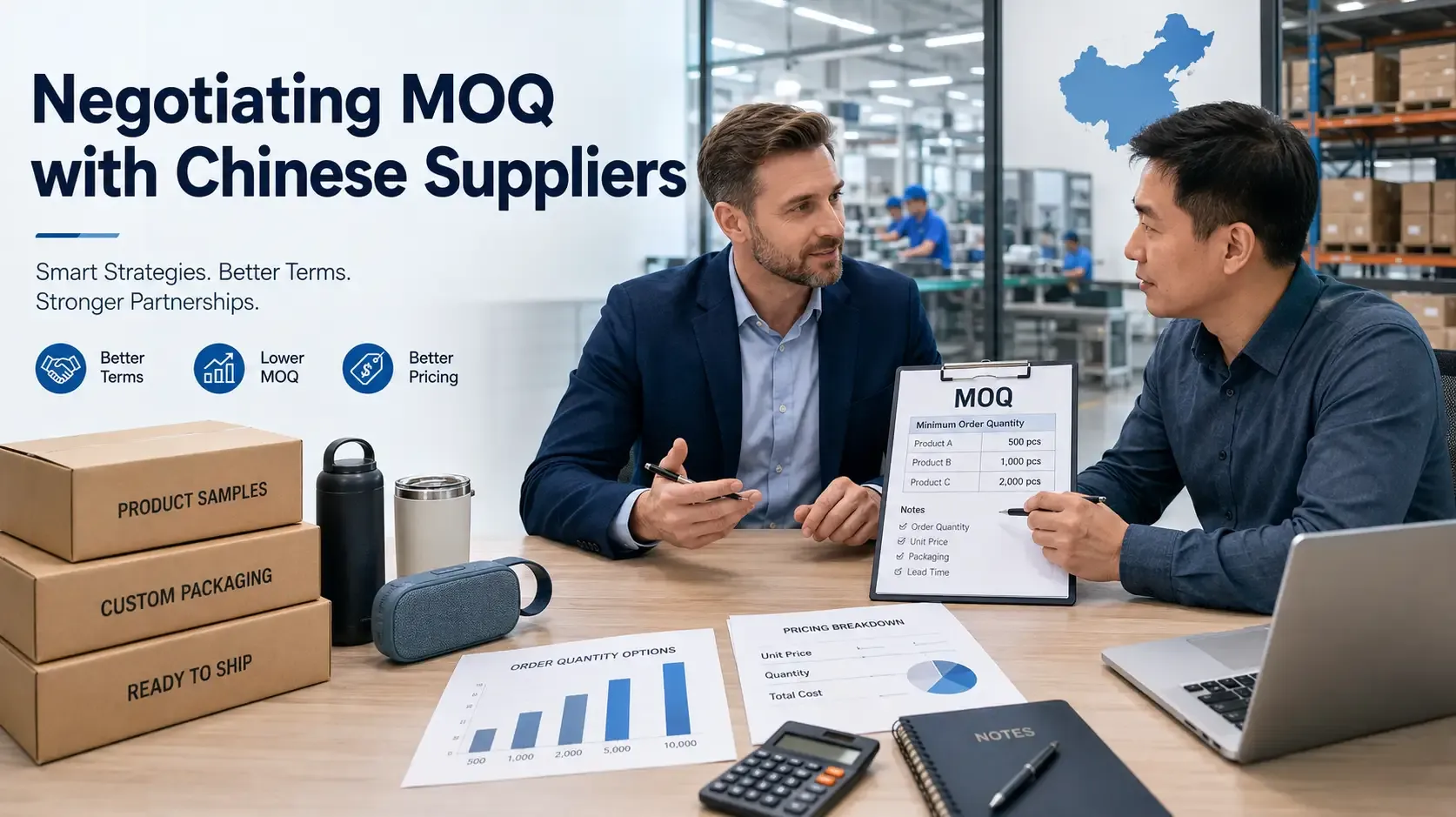
Minimum order quantity, commonly known as MOQ, is one of the first issues international buyers encounter when purchasing products from China.
A supplier may quote an attractive unit price but require 1,000 pieces per color. Another supplier may accept only 300 pieces, while a wholesaler offering ready-stock products may allow buyers to start with just a few cartons.
For new importers, small businesses, online retailers, and buyers testing a new product category, these differences can have a major impact on purchasing decisions.
The important thing to understand is that MOQ is not always a fixed number.
In many cases, it reflects the supplier's production costs, material requirements, packaging quantities, customization level, and willingness to accommodate a particular order.
This guide explains how MOQ works, why Chinese suppliers set minimum order quantities, and how buyers can negotiate more effectively without creating unnecessary quality or cost risks.
What Does MOQ Mean?
MOQ stands for Minimum Order Quantity.
It is the smallest quantity a supplier is normally willing to sell or manufacture under a specific set of conditions.
For example, a supplier may quote:
- 500 pieces per style
- 300 pieces per color
- 1,000 pieces for custom packaging
- 5,000 pieces for a custom-printed component
- 1 carton for ready-stock wholesale products
The important detail is that MOQ can apply to different parts of an order.
A product may have one production MOQ while the packaging supplier, fabric mill, printing factory, or accessory supplier has another.
This is why buyers should never look only at the number shown on a product page. They should ask what the MOQ actually applies to.
Why Do Chinese Suppliers Have MOQs?
Suppliers usually do not create MOQs simply to make life difficult for smaller buyers.
Production has fixed costs.
Before a factory can manufacture a product, it may need to prepare machinery, purchase raw materials, create printing plates, adjust colors, prepare molds, arrange labor, test samples, and set up packaging.
If the order is too small, these costs are spread across too few units.
The result is often an order that is commercially unattractive for the supplier.
Raw Material Minimums
Many factories do not manufacture every component themselves.
They purchase materials from upstream suppliers.
For example, a finished-product supplier may need to purchase:
- fabric
- plastic resin
- stainless steel parts
- paper
- cartons
- zippers
- labels
- printing materials
- packaging accessories
These upstream suppliers may also impose their own MOQs.
Even when the final factory is willing to accept a smaller order, its material suppliers may make that difficult.
Production Setup Costs
Factories often need to adjust machinery or production lines for a new order.
A short production run may require almost the same setup process as a larger order.
For this reason, factories generally prefer to spread setup costs across more units.
Custom Colors
Custom colors frequently increase MOQ.
If you are willing to use an existing material or standard color, the supplier may already have stock available.
But if you request a specific Pantone color, the factory may need to order or produce a new batch of material.
This can significantly increase the minimum quantity.
Custom Packaging
Packaging is one of the most common reasons buyers unexpectedly encounter higher MOQs.
The product factory may accept 300 pieces, but the printing factory producing custom boxes may require 1,000 or 3,000 boxes.
This is why buyers should discuss both product MOQ and packaging MOQ before confirming an order.
Printing and Logo Requirements
Simple logo applications may be possible at relatively low quantities.
However, processes such as:
- screen printing
- heat transfer
- embroidery
- foil stamping
- custom labels
- molded logos
- engraved logos
- full-color printed packaging
can each have their own setup costs and quantity requirements.
The more customization you request, the harder it normally becomes to maintain a very low MOQ.
Is MOQ Negotiable?
Often, yes.
But successful MOQ negotiation does not mean simply asking:
“Can you lower the MOQ?”
A better negotiation starts by understanding why the MOQ exists.
If the factory says the MOQ is 1,000 pieces because the customized material must be produced in a minimum batch, it may be difficult to reduce that number while keeping all specifications unchanged.
However, if the MOQ is based mainly on production efficiency, packaging, or a supplier's standard sales policy, there may be more room for negotiation.
The key is to change the structure of the order rather than simply demand a lower number.
1. Ask Whether the MOQ Is Fixed
Start with a direct question:
Is the MOQ fixed, or is a smaller trial order possible?
This helps identify whether the quoted quantity is a strict production requirement or simply the supplier's standard policy.
Some suppliers publish higher MOQs because they prefer larger orders, even though they are technically capable of accepting smaller quantities.
Others have real material or production constraints.
The negotiation strategy should be different in each case.
2. Ask for a Trial Order
One of the most effective approaches is to explain that the first order is intended as a market test.
For example, instead of saying:
“Your MOQ is too high.”
you can explain:
“We would like to test this product in our market first. Can we start with a smaller trial order and increase the quantity if sales perform well?”
This gives the supplier a commercial reason to consider the request.
A supplier may be more willing to accept a smaller first order if there is realistic potential for repeat business.
However, buyers should avoid making exaggerated promises about future volumes simply to obtain a lower MOQ.
A sustainable supplier relationship is more valuable than winning a small concession on the first purchase.
3. Accept a Higher Unit Price for a Lower MOQ
Lower quantities usually mean higher unit costs.
This is normal.
For example, a supplier might quote:
- 1,000 pcs at $2.20
- 500 pcs at $2.45
- 300 pcs at $2.75
The smaller order may still make commercial sense if it significantly reduces inventory risk.
Many new buyers focus too heavily on obtaining the lowest unit price.
But saving $0.30 per unit is not necessarily helpful if it forces you to purchase hundreds of units you cannot sell.
The right order quantity should balance price, inventory risk, freight cost, and expected demand.
For a broader look at supplier quotations and pricing strategy, read our guide on how to negotiate wholesale prices with Chinese suppliers.
4. Use Existing Colors and Materials
Customization is one of the biggest drivers of MOQ.
If your first order does not need completely unique materials, ask the supplier which colors or materials are already available.
Using existing stock may allow the supplier to accept a much smaller quantity.
For example, instead of requiring a custom Pantone color, you might select from several colors the supplier already produces regularly.
Once the product has proven demand, you can move to a fully customized version in later orders.
5. Simplify the Packaging
Custom packaging can sometimes create a higher MOQ than the product itself.
For a trial order, consider using:
- standard cartons
- neutral boxes
- standard polybags
- stickers
- simple printed labels
- standard packaging with a branded insert
instead of fully customized retail packaging.
This can significantly reduce the amount of inventory committed to packaging alone.
It also gives buyers more flexibility if the product specification or branding changes later.
6. Reduce the Number of Colors or Variants
Suppose a factory requires an MOQ of 500 pieces per color.
Ordering five colors immediately would result in 2,500 pieces.
For a new product, this may be unnecessarily risky.
Instead, consider launching with two or three core colors.
Fewer SKUs usually mean:
- easier inventory management
- lower purchasing capital
- simpler quality control
- less leftover stock
- easier market testing
After identifying the best-selling colors, future orders can be adjusted accordingly.
7. Ask Whether Multiple Variants Can Share the MOQ
Sometimes a supplier can combine different designs, sizes, or colors within one total production quantity.
For example:
Standard condition:
500 pcs per color
Possible negotiated structure:
1,000 pcs total across three existing colors
Whether this is possible depends heavily on the product and production process.
A buyer should therefore ask:
“Does the MOQ apply per color, per design, or to the total order?”
That single question can make a major difference to the total investment required.
8. Use Existing Products Instead of Full Custom Development
There is an important difference between ready-stock wholesale products and custom manufacturing.
Ready-stock goods can often be purchased at much lower quantities because the supplier has already produced them.
Custom manufacturing may require new materials, colors, tooling, packaging, or production preparation.
For buyers testing a completely new category, starting with an existing product and adding limited branding can sometimes be a more practical strategy than developing a fully customized product immediately.
9. Consolidate Several Products
Buyers purchasing multiple product categories may sometimes have more negotiating flexibility when the overall purchasing volume is larger.
For example, instead of managing several isolated small orders, an importer might source:
- water bottles
- gift bags
- towels
- household products
- promotional items
as part of a larger purchasing project.
Each factory will still have its own production requirements, but coordinating several suppliers can make the overall purchasing process more efficient.
This is particularly relevant for retailers, importers, distributors, promotional companies, and businesses sourcing a mixed assortment from China.
Working through an established Supplier Network can also help buyers identify alternative suppliers when one factory's MOQ does not match the project.
10. Compare More Than One Supplier
A high MOQ from one supplier does not necessarily mean every supplier in China has the same requirement.
Factories have different:
- equipment
- production lines
- customer profiles
- material suppliers
- inventory levels
- order schedules
- specialization
A factory primarily serving large international brands may have little interest in a 300-piece order.
Another supplier specializing in small and medium-sized wholesale buyers may be perfectly comfortable with it.
This is why supplier comparison should include more than unit price.
Buyers should compare:
- MOQ
- unit price
- product quality
- customization options
- sampling
- production lead time
- packaging
- quality control
- communication
- export capability
The cheapest supplier is not always the lowest-risk supplier.
When Should You Avoid Pushing the MOQ Too Low?
Lower MOQ is useful, but it is not always better.
If a supplier repeatedly explains that the requested quantity is below the practical production minimum, pushing too aggressively can create problems.
The supplier may agree to the order but compensate elsewhere.
Possible consequences include:
- higher pricing
- limited customization
- inconsistent production
- reduced flexibility for remakes
- lower priority during busy production periods
A good negotiation should create a workable order for both buyer and supplier.
The objective is not to force the factory to accept an uneconomical order.
The objective is to find the smallest practical quantity that still allows the product to be manufactured correctly.
MOQ and Quality Control
Quality requirements should not be relaxed simply because an order is small.
Before mass production, buyers should confirm:
- approved product specifications
- materials
- dimensions
- colors
- logo position
- packaging
- labeling
- workmanship standards
- inspection requirements
A small trial order is often used to reduce market risk, but it can also be used to evaluate the supplier's production consistency.
SML Supply's Quality Control process focuses on checking products against agreed specifications before shipment.
When buyers plan to place repeat orders, the first production run provides useful information about both the product and the supplier.
MOQ for Wholesale Products vs Custom Manufacturing
The type of purchasing model strongly affects MOQ.
Ready-Stock Wholesale
These products are already produced or available from existing inventory.
MOQ may be:
- one carton
- several dozen pieces
- a mixed assortment
- a small value-based minimum order
This model can be suitable for testing products quickly.
Light Customization
The product already exists, but the buyer adds elements such as:
- logo
- label
- sticker
- simple packaging
- selected colors
MOQ is usually higher than ready-stock purchasing but lower than completely custom development.
OEM or Private Label Production
The supplier manufactures according to buyer requirements.
This may involve:
- specific dimensions
- materials
- colors
- branding
- packaging
- product modifications
MOQ depends on the production process and upstream material requirements.
Fully Custom Product Development
New tooling, molds, components, or technical development can result in significantly higher minimum quantities and setup costs.
Before starting a custom product, buyers should understand exactly which part of the supply chain creates the MOQ.
Questions to Ask a Supplier About MOQ
Before negotiating, ask the supplier clear questions.
What Is the MOQ per Product?
Do not assume the displayed MOQ applies to the entire order.
Is the MOQ per Color or Total Quantity?
This is particularly important for apparel, textiles, plastic products, and other color-dependent products.
Can Different Sizes Be Mixed?
Some factories allow size assortments within one color MOQ.
Is There a Separate MOQ for Custom Packaging?
Packaging requirements can change the economics of an otherwise small order.
Can I Use Existing Materials or Colors?
Available materials may dramatically reduce the production minimum.
What Is the Price for a Smaller Trial Order?
Instead of demanding the same unit price, ask the supplier to quote alternative quantities.
What Changes Would Reduce the MOQ?
This is one of the most useful questions a buyer can ask.
It shifts the discussion from:
“Lower your MOQ.”
to:
“How can we redesign the order so a lower MOQ becomes practical?”
That usually creates a more productive negotiation.
Example of a Practical MOQ Negotiation
Imagine a buyer wants to purchase a custom product.
The supplier quotes:
MOQ: 1,000 pcs per color
The buyer only wants 500 pieces for the first order.
Instead of simply asking the supplier to cut the MOQ in half, the buyer investigates the reason.
The supplier explains that the custom color requires a minimum material batch.
The buyer could then consider several alternatives.
Option 1: Use an Existing Color
If the factory already has material available, 500 pieces may become possible.
Option 2: Purchase 1,000 Pieces Across Fewer SKUs
Instead of several colors, the buyer selects one core color.
Option 3: Accept a Higher Price
The supplier absorbs additional setup or material costs in exchange for a higher unit price.
Option 4: Use Standard Packaging
The product remains customized, but the buyer removes custom packaging from the first order.
Option 5: Find Another Suitable Supplier
A smaller factory or supplier with different production conditions may be more appropriate.
This is what effective MOQ negotiation actually looks like.
It is usually a process of changing one or more commercial variables rather than simply bargaining over a single number.
How Buyers Should Evaluate a Lower MOQ Offer
When a supplier accepts a surprisingly low MOQ, buyers should still ask how the order will be produced.
A lower minimum is useful only if the supplier can maintain the required product quality.
Check whether:
- materials are unchanged
- production methods are unchanged
- packaging meets requirements
- existing stock is being used
- colors will remain consistent
- quality standards remain the same
If the supplier changes materials or specifications in order to accommodate the small order, the buyer should approve those changes before production.
MOQ Is Only One Part of the Buying Decision
A low MOQ can reduce inventory risk, but buyers should not evaluate an order based on MOQ alone.
The complete purchasing decision should include:
Product cost + customization cost + packaging + inspection + freight + duties + inventory risk.
Sometimes a slightly larger order makes sense because it lowers production and freight costs.
In other cases, paying a higher unit price for a smaller quantity is the safer choice.
The right answer depends on the buyer's sales volume, cash flow, market confidence, and ability to manage inventory.
If you are deciding how many units to purchase for your first or repeat order, see our guide on how much you should order from a Chinese supplier.
Working With a China Sourcing Partner
MOQ negotiation becomes more complicated when a project involves several factories, different materials, custom packaging, or multiple product categories.
A China sourcing partner can help compare supplier requirements, identify alternatives, coordinate samples, and determine which parts of an order are creating unnecessarily high minimum quantities.
SML Supply works with international B2B buyers on China sourcing, supplier coordination, product development, quality control, and export support.
If your project requires custom development, you can learn more about our Product Development process.
For buyers who already have a product requirement and want help finding suitable suppliers, you can also submit a Request Sourcing inquiry.
Final Thoughts
MOQ should be treated as a commercial variable, not simply as a number that must be accepted or rejected.
The best way to negotiate a lower MOQ is to understand what creates the minimum quantity in the first place.
Buyers can often improve the situation by:
- using existing materials
- reducing color variations
- simplifying packaging
- accepting a higher unit price
- starting with ready-stock products
- placing a trial order
- consolidating purchasing
- comparing alternative suppliers
At the same time, pushing the quantity too low can create higher costs or production risks.
The goal should be to find an order structure that allows you to test the market while still giving the supplier enough volume to manufacture the product properly.
For international buyers, a well-negotiated MOQ is not simply the lowest quantity possible.
It is the quantity that creates the best balance between cost, quality, inventory risk, and future purchasing potential.Published by: SML Supply