Oct 24, 2026Wholesale Buying Guide
How to Buy Multiple Product Categories from China: A Practical Guide for Importers and Wholesalers
Learn how to source multiple product categories from China, coordinate suppliers, manage MOQs, quality, consolidation, shipping, and total purchasing costs.
Author: Connor Ma, Founder of SML Supply
Published by: SML Supply
Buying one product from one Chinese supplier is relatively straightforward.
Buying five, ten, or twenty different product categories from several suppliers is a very different purchasing challenge.
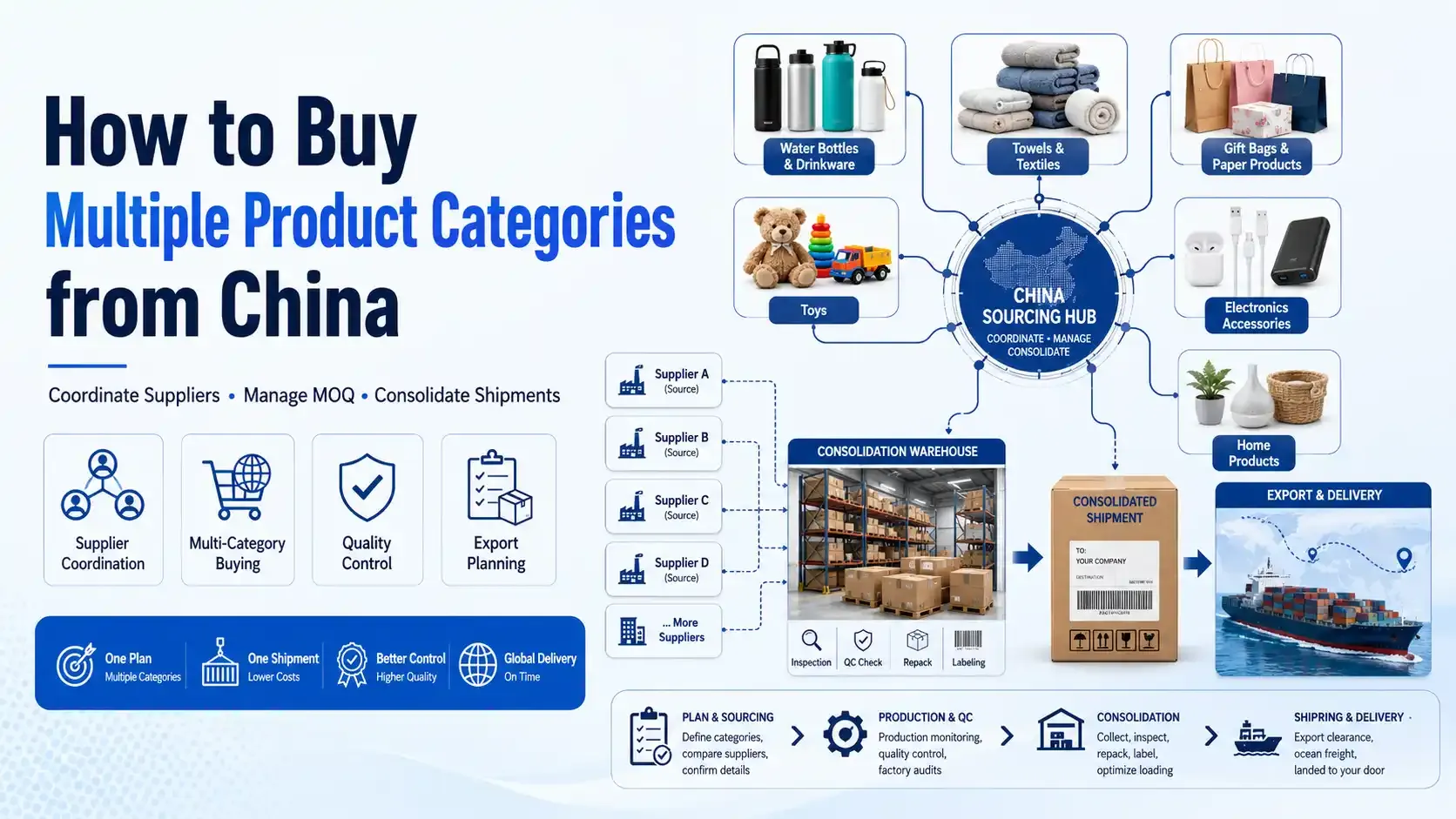
A retailer may need water bottles, towels, gift bags, toys, household accessories, and promotional products for the same purchasing program. A distributor may want to build a mixed product assortment rather than import one large-volume item. A promotional company may need several different products delivered together for one customer or event.
In these situations, the main challenge is no longer simply finding a supplier.
The buyer must coordinate:
- different suppliers
- different MOQs
- different production schedules
- different payment terms
- different packaging requirements
- different quality standards
- different carton sizes
- different completion dates
- different shipping arrangements
Without proper coordination, a multi-category purchasing project can quickly become difficult to manage.
This guide explains how international buyers can purchase multiple product categories from China more efficiently while controlling supplier risk, inventory, quality, logistics, and total purchasing cost.
What Does Multi-Category Sourcing Mean?
Multi-category sourcing means purchasing products from several different product categories as part of one broader purchasing program.
For example, a buyer may source:
- stainless steel water bottles
- plastic drinkware
- towels
- gift bags
- toys
- home organization products
- beauty accessories
- electronic accessories
These products are unlikely to come from the same factory.
A towel manufacturer normally does not produce water bottles.
A paper bag factory normally does not manufacture electronic accessories.
A toy supplier may have completely different production processes from a textile factory.
Therefore, multi-category sourcing usually involves coordinating several specialized suppliers instead of looking for one factory that produces everything.
Why Do Buyers Purchase Multiple Categories from China?
There are several common reasons.
Retail Product Assortments
Retailers often need hundreds or thousands of SKUs across many categories.
Instead of importing only one product, they need a complete assortment for:
- stores
- online shops
- seasonal promotions
- new collections
- private-label programs
Wholesale Distribution
Distributors may supply different products to the same group of customers.
Purchasing several categories from China can allow them to expand their product range without relying on one manufacturer.
Promotional Products
Promotional companies frequently need different products for the same campaign.
For example:
- bottles
- tote bags
- towels
- notebooks
- gift packaging
- accessories
These products may all require the same logo but come from completely different factories.
E-Commerce Businesses
Online sellers may test several product categories at the same time.
Rather than investing heavily in one SKU, they may purchase smaller quantities across a wider product assortment.
Importers and Buying Offices
Some importers purchase products on behalf of retailers, distributors, hotels, companies, or other business customers.
Their purchasing work naturally involves several suppliers and product categories.
The Main Difficulty: One Order Becomes Many Orders
From the buyer's perspective, the project may feel like one purchasing program.
From the supplier side, however, it may actually be:
Supplier A: bottles
Supplier B: towels
Supplier C: gift bags
Supplier D: toys
Supplier E: packaging
Each supplier operates independently.
Each supplier may have different:
- MOQ
- unit price
- production time
- packaging
- deposit requirement
- quality standard
- shipping location
This means the buyer must manage several smaller supply chains at the same time.
The more suppliers involved, the more coordination becomes necessary.
Start With a Clear Product List
Before contacting suppliers, create a master purchasing list.
At minimum, include:
- product name
- reference image
- specification
- material
- size
- color
- target quantity
- logo requirement
- packaging requirement
- target price if applicable
- required delivery date
- destination market
Do not manage a large purchasing project only through scattered emails or chat messages.
A structured product list creates one central reference for the entire project.
For example:
Product | Quantity | Customization | Packaging |
|---|---|---|---|
Stainless Steel Bottle | 1,000 pcs | Logo | Individual Box |
Face Towel | 2,000 pcs | Woven Label | Polybag |
Gift Bag | 3,000 pcs | Existing Design | Standard Carton |
Stress Relief Toy | 1,000 pcs | Custom Color | Display Box |
This immediately makes the project easier to evaluate.
Group Products by Supplier Type
The next step is to divide products into logical sourcing groups.
For example:
Drinkware
- plastic bottles
- stainless steel bottles
- insulated bottles
Textiles
- hand towels
- face towels
- bath towels
- cooling towels
Paper Products
- gift bags
- wine bags
- birthday bags
Toys
- sensory toys
- stress relief products
This helps buyers determine whether several related items can be purchased from one specialized supplier.
A strong Supplier Network is particularly useful in multi-category projects because the objective is not simply to locate one supplier, but to match each category with the appropriate manufacturing source.
Do Not Expect One Factory to Manufacture Everything
One common mistake is trying to find a single factory that claims to produce many unrelated products.
A company offering:
- towels
- electronics
- toys
- kitchen products
- gift bags
- beauty accessories
is unlikely to manufacture all of those products itself.
This does not automatically mean the supplier is unreliable.
It may be:
- a trading company
- sourcing company
- wholesaler
- export company
The important point is to understand the supplier's actual role.
For technically important or customized products, buyers should know which factory is responsible for production.
For standard wholesale goods, working through a trading or sourcing structure may sometimes be practical, especially when the main objective is to combine several low-volume categories.
Different Products Will Have Different MOQs
Multi-category sourcing becomes complicated because every supplier has its own minimum quantity requirements.
For example:
Bottle supplier:
MOQ: 500 pcs per color
Towel supplier:
MOQ: 1,000 pcs per design
Gift bag supplier:
MOQ: 1,000 pcs per size
Toy supplier:
MOQ: 2,000 pcs per item
The buyer therefore cannot simply say:
“My total order is 5,000 pieces.”
From the factories' perspective, these are separate production orders.
Each factory must still satisfy its own production economics.
If one supplier's MOQ is too high for your project, see our guide on how to negotiate MOQ with Chinese suppliers.
Use Existing Products to Reduce Multi-Category MOQ
When purchasing many categories, full customization on every product can create excessive MOQ requirements.
A more practical strategy may be:
Core products: fully customized
Secondary products: light customization
Test products: existing designs or ready stock
For example:
A retailer may develop a fully customized private-label bottle but use existing towel colors and standard gift bag designs.
This approach allows the buyer to create a branded assortment without committing to high production quantities across every category.
Compare Order Quantity Across the Whole Project
When purchasing multiple categories, each individual order may look small.
But together they may represent a significant investment.
For example:
Bottles:
$4,000
Towels:
$3,500
Gift bags:
$2,000
Toys:
$3,000
Packaging:
$1,500
Total product purchasing:
$14,000
Buyers should therefore evaluate both:
individual supplier order value
and
total project investment.
If you are unsure how much stock to purchase for each product, see our guide on how much you should order from a Chinese supplier.
The correct quantity for one product does not necessarily apply to another.
Do Not Use the Same Inventory Strategy for Every Product
Different products have different inventory risks.
For example:
Stable Products
Basic towels or standard household goods may have relatively stable demand.
Seasonal Products
Christmas gift bags have a limited selling window.
Trend Products
Toys or fashion accessories can lose popularity quickly.
Electronics
Electronic products may be replaced by updated versions.
Therefore, multi-category buyers should not simply allocate the same inventory budget to every product.
The order quantity should reflect:
- expected sales
- product life cycle
- seasonality
- replenishment time
- supplier MOQ
- cash flow
Create One Master Supplier Comparison Sheet
For each product category, compare suppliers using the same structure.
Useful information includes:
- supplier name
- product
- unit price
- MOQ
- material
- specification
- sample cost
- customization cost
- packaging
- production lead time
- payment terms
- factory location
- carton dimensions
- gross weight
- Incoterm
- inspection requirement
This becomes particularly important when five or more suppliers are involved.
Without a central comparison sheet, quotation details can easily become mixed between suppliers.
If price negotiation is an important part of your purchasing process, see our guide on how to negotiate wholesale prices with Chinese suppliers.
Standardize Your RFQs
When several suppliers are quoting related products, use consistent RFQ formats.
For example, every supplier should receive:
- reference image
- target material
- dimensions
- quantity
- color
- logo requirement
- packaging
- destination
- target schedule
This reduces quotation errors.
A supplier quoting standard packaging should not be compared directly with another supplier quoting custom packaging.
The more standardized your requests are, the easier it becomes to compare suppliers.
Keep Product Specifications Separate
A multi-category project can involve hundreds of product details.
Do not combine everything into one vague specification.
Each product should have its own approved information.
For example:
Product A — Stainless Steel Bottle
- 500 ml
- stainless steel body
- black
- laser logo
- individual box
Product B — Face Towel
- 34 × 75 cm
- cotton
- 400 GSM
- white
- woven label
Product C — Gift Bag
- 26 × 32 × 12 cm
- paper
- foil logo
- rope handle
Each product should be treated as its own production specification even if all products belong to the same purchasing project.
Sampling Becomes More Important
With one product, a buyer may only need one sample approval.
With multiple categories, sample coordination becomes much more complex.
You may need:
- product sample
- color sample
- logo sample
- packaging sample
- pre-production sample
from several different suppliers.
Create a sample status sheet.
For example:
Product | Sample Status | Logo Approved | Packaging Approved |
|---|---|---|---|
Bottle | Approved | Yes | Yes |
Towel | Revision Required | Yes | Pending |
Gift Bag | Approved | N/A | Yes |
Toy | Pending | Pending | Pending |
This prevents one unfinished sample from being forgotten while other products move forward.
Product Development Should Be Separated From Standard Wholesale Purchasing
Not every item in a multi-category project requires the same sourcing process.
Some products may already exist.
Others may require:
- new mold
- new size
- custom color
- new packaging
- new material
- private label
- structural changes
These products require additional development time.
For custom projects, SML Supply's Product Development process can help coordinate specifications and sampling before mass production.
Buyers should not assume that custom-developed products will follow the same timeline as ready-stock items.
Different Suppliers Will Finish at Different Times
This is one of the biggest practical issues in multi-category sourcing.
Imagine:
Supplier A finishes in 20 days
Supplier B finishes in 30 days
Supplier C finishes in 40 days
Supplier D finishes in 50 days
If all goods need to ship together, Supplier A's products may need to wait several weeks.
This can create:
- warehouse costs
- storage risk
- delayed payment cycles
- inventory planning problems
The project therefore needs one master production schedule.
Build a Master Production Timeline
For each supplier, record:
- deposit date
- material preparation
- sample approval
- production start
- expected completion
- inspection date
- warehouse delivery date
- planned export date
For example:
Supplier | Product | Production Complete | Inspection | Warehouse |
|---|---|---|---|---|
A | Bottles | Sept 10 | Sept 12 | Sept 14 |
B | Towels | Sept 15 | Sept 17 | Sept 19 |
C | Gift Bags | Sept 20 | Sept 22 | Sept 24 |
D | Toys | Sept 25 | Sept 27 | Sept 29 |
Now the buyer can identify the realistic consolidation date.
Avoid Starting Every Supplier at Random Times
If orders are intended to ship together, production timing should be planned backward from the target export date.
For example:
Target shipment:
October 10
Latest warehouse consolidation:
October 5
Inspection completion:
September 30
Products should therefore be scheduled to finish before this date.
Without a master plan, one late supplier can delay the entire consolidated shipment.
Quality Control Must Remain Product-Specific
Combining several suppliers does not mean all products can use one generic quality checklist.
Different categories require different inspection points.
Bottles
Possible checks include:
- capacity
- leakage
- lid fit
- printing
- surface finish
- packaging
Towels
Possible checks include:
- dimensions
- GSM
- material
- color
- stitching
- absorbency
- labeling
Gift Bags
Possible checks include:
- dimensions
- printing
- foil quality
- handle attachment
- folding
- carton packing
Toys
Possible checks include:
- material
- appearance
- function
- packaging
- labeling
- safety requirements
Every product should be inspected against the specification approved for that product.
SML Supply's Quality Control process helps buyers check products against agreed requirements before shipment.
Do Not Wait Until Consolidation to Discover Quality Problems
If five suppliers all deliver goods to a warehouse and only then the buyer discovers that one product is incorrect, the entire shipping plan may be disrupted.
Whenever possible, inspection should take place before the products are treated as shipment-ready.
If a problem is discovered, there is still time to:
- rework
- replace
- repack
- relabel
- reproduce
before final consolidation.
Standardize Carton Markings
Multiple suppliers often use different carton markings.
This can create confusion at the warehouse and destination.
Consider creating a standard carton mark containing:
- buyer name
- PO number
- product code
- carton number
- quantity
- destination
- country of origin if required
For example:
PO: SML2026-018
Item: WB-001
Qty: 50 PCS
Carton: 1/20
A consistent carton-marking system makes receiving and distribution easier.
Ask Every Supplier for Packing Data
Before consolidation, collect:
- number of cartons
- units per carton
- carton dimensions
- gross weight
- net weight
- total CBM
This allows the total shipment to be estimated.
For example:
Supplier A:
20 cartons
1.8 CBM
Supplier B:
35 cartons
2.5 CBM
Supplier C:
15 cartons
1.2 CBM
Supplier D:
40 cartons
3.0 CBM
Total:
110 cartons
8.5 CBM
Without accurate packing data, freight planning becomes difficult.
What Is Order Consolidation?
Order consolidation means bringing goods from multiple suppliers together before export.
For example:
Factory A → consolidation warehouse
Factory B → consolidation warehouse
Factory C → consolidation warehouse
Factory D → consolidation warehouse
Then:
Consolidated shipment → destination country
This can simplify logistics for buyers purchasing several categories.
However, consolidation should not be assumed to automatically save money.
It must be evaluated based on the actual shipment.
When Consolidation Can Make Sense
Consolidation may be useful when:
- suppliers are geographically accessible
- orders finish within similar dates
- shipment sizes are relatively small
- goods can use the same shipping method
- products have compatible customs requirements
- the buyer wants one coordinated shipment
Possible benefits include:
- fewer separate international shipments
- easier shipment coordination
- better visibility
- simpler destination receiving
- potential freight efficiency
When Consolidation May Not Make Sense
Sometimes separate shipping is better.
For example:
- one product is urgently needed
- suppliers finish months apart
- goods require different transportation methods
- one product needs special handling
- one order already fills a container
- products have different destination markets
The purpose of consolidation is efficiency.
It should not be used simply because several suppliers exist.
Calculate the Total Landed Cost of the Whole Project
Multi-category buyers should calculate costs at two levels.
Project Level
What is the total cost of the complete shipment?
This may include:
- products
- domestic transportation
- consolidation
- inspection
- export handling
- international freight
- duties
- customs
- final delivery
Product Level
How much landed cost should be allocated to each individual product?
This is important because different products may have different:
- value
- weight
- volume
- duty rates
If you need a complete explanation of these costs, see our guide on how to calculate landed cost when buying wholesale from China.
Do Not Allocate Freight Equally Across Products
Suppose a shipment contains:
1,000 bottles
and
5,000 paper gift bags.
Dividing total freight simply by 6,000 units may produce misleading product costs.
The bottles may account for much more weight.
The gift bags may account for more volume.
A more appropriate allocation may use:
- weight
- CBM
- chargeable weight
- product value
depending on the situation.
This matters when determining the true profitability of each category.
Different Products May Have Different Import Requirements
A mixed shipment can contain products with different customs classifications.
For example:
- textiles
- plastics
- steel products
- toys
- electronics
Each product may require its own:
- HS code
- duty rate
- product description
- regulatory documentation
Buyers should not assume that one tariff classification applies to the whole shipment.
The more categories involved, the more important accurate documentation becomes.
Confirm Destination Market Requirements Early
Before purchasing, determine whether products need:
- labeling
- testing
- certification
- warnings
- material declarations
- compliance documents
Requirements vary by product and destination market.
A promotional gift bag and an electronic product may have very different compliance considerations.
These issues should be checked during sourcing, not after production has finished.
Payment Management Becomes More Complex
With one supplier, the buyer may only track:
- deposit
- balance
With six suppliers, there may be:
- six deposits
- six balances
- sample payments
- packaging payments
- inspection costs
- warehouse charges
- freight payments
Create a payment tracking sheet.
Useful fields include:
- supplier
- order value
- deposit
- deposit paid date
- balance
- balance due
- payment status
- invoice number
This helps avoid missed or duplicate payments.
Use Purchase Order Numbers
Each supplier order should have a clear reference.
For example:
PO-2026-001 — Bottles
PO-2026-002 — Towels
PO-2026-003 — Gift Bags
PO-2026-004 — Toys
Using PO numbers makes it easier to connect:
- supplier quotation
- payment
- sample
- production
- inspection
- carton marks
- shipping documents
A multi-category project becomes much harder to manage if every order is identified only by casual product descriptions.
Keep Communication Organized
One of the hidden costs of multi-category sourcing is communication.
Imagine managing eight suppliers through separate:
- emails
- WhatsApp chats
- WeChat chats
- spreadsheets
- files
- invoices
Important information can easily be lost.
Create a central project record.
At minimum, maintain:
- product specification
- supplier quotation
- sample approval
- payment record
- production status
- inspection result
- packing list
This reduces dependency on chat history.
Do Not Change Specifications Casually
When many suppliers are involved, specification changes can create chain reactions.
For example, changing packaging may affect:
- price
- MOQ
- production date
- carton size
- freight estimate
- artwork
- barcode
Every change should therefore be documented.
A useful process is:
Original specification → Revision → Supplier confirmation → Final approval
Do not assume that a change discussed in a chat has automatically been applied to production.
Use a Master Project Status Sheet
A simple project status sheet might look like:
Product | Supplier | Sample | Production | Inspection | Ready to Ship |
|---|---|---|---|---|---|
Bottle | A | Approved | Complete | Passed | Yes |
Towel | B | Approved | 80% | Pending | No |
Gift Bag | C | Approved | Complete | Passed | Yes |
Toy | D | Approved | 60% | Pending | No |
This gives the buyer an immediate view of the complete project.
Without this overview, multi-supplier purchasing can become difficult to control.
Should You Use One Sourcing Partner for Multiple Categories?
For some buyers, managing every supplier directly is practical.
This is particularly true when:
- supplier count is small
- order values are large
- products are highly specialized
- the buyer has an experienced sourcing team
However, a sourcing partner can be useful when:
- many small suppliers are involved
- products come from different categories
- suppliers are difficult to coordinate
- consolidation is required
- inspections need to be arranged
- the buyer is outside China
- export coordination is complex
The main value is not that one sourcing company manufactures every product.
The value is that one party can help coordinate the separate suppliers into one organized purchasing project.
Direct Factory Buying vs Coordinated Sourcing
These are not necessarily competing approaches.
A buyer may purchase directly from several factories while using a sourcing partner to help coordinate:
- communication
- samples
- production
- inspection
- consolidation
- shipping
Alternatively, the sourcing partner may handle the entire supplier relationship.
The appropriate structure depends on:
- project size
- product complexity
- buyer experience
- supplier count
- level of control required
Example: A Multi-Category Buying Project
Imagine a retailer wants to source six products from China:
Product 1
Stainless steel bottles
Supplier A
1,000 pcs
Product 2
Cooling towels
Supplier B
2,000 pcs
Product 3
Birthday gift bags
Supplier C
3,000 pcs
Product 4
Stress relief toys
Supplier D
1,500 pcs
Product 5
Kids cameras
Supplier E
500 pcs
Product 6
Tablet styluses
Supplier F
1,000 pcs
This project involves six suppliers and six product categories.
The buyer should not manage it as six unrelated transactions.
Instead, create one purchasing project.
Step 1: Confirm Specifications
Every product receives its own specification sheet.
Step 2: Compare Supplier Terms
Confirm:
- MOQ
- price
- lead time
- packaging
- payment
- customization
Step 3: Approve Samples
No mass production starts before the required sample approvals are completed.
Step 4: Coordinate Production
Factories receive target completion dates based on the overall shipping plan.
Step 5: Track Production
A central status sheet is updated regularly.
Step 6: Inspect Each Product
Each category uses an appropriate quality checklist.
Step 7: Collect Packing Data
Every supplier submits final carton quantities, dimensions, and weights.
Step 8: Consolidate Where Appropriate
Completed goods are sent to the planned warehouse or shipping point.
Step 9: Prepare Export Documents
Product descriptions, quantities, values, and classifications are organized correctly.
Step 10: Ship and Track Landed Cost
International freight and destination expenses are recorded against the purchasing project.
This is the difference between simply buying many products and professionally managing a multi-category sourcing program.
Common Mistakes When Buying Multiple Categories
Choosing One Supplier for Everything
A supplier with an extremely wide unrelated product range may not actually manufacture those products.
Understand who is producing each item.
Focusing Only on Unit Price
A cheap quotation may create higher packaging, quality, or logistics costs.
Ignoring Different MOQs
Each factory has its own production requirements.
Starting Production Without a Master Schedule
One late supplier can delay the entire consolidated shipment.
Mixing Product Specifications
Every product needs its own approved requirements.
Inspecting Only at the End
Quality problems should be found before final consolidation whenever possible.
Forgetting Packing Data
Freight planning requires carton dimensions, quantity, and weight.
Assuming Consolidation Is Always Cheaper
Calculate the actual logistics cost.
Treating Every Product as the Same Inventory Risk
Seasonal and trend products require different purchasing strategies.
Losing Information in Chat Messages
Use structured project documents rather than relying only on conversation history.
A Practical Multi-Category Purchasing Checklist
Before placing the orders, confirm:
Products
- product specifications
- materials
- sizes
- colors
- customization
- packaging
Suppliers
- supplier identity
- manufacturing capability
- MOQ
- quotation
- payment terms
- lead time
Samples
- product approval
- color approval
- logo approval
- packaging approval
Production
- deposit date
- production schedule
- completion date
- inspection date
Quality
- inspection standard
- approved reference
- defect criteria
- packaging requirements
Logistics
- cartons
- carton dimensions
- gross weight
- total CBM
- supplier location
- warehouse destination
- shipping method
Cost
- product price
- domestic transportation
- inspection
- consolidation
- freight
- duties
- customs
- final delivery
A project that has these areas under control is much easier to manage.
How SML Supply Supports Multi-Category Sourcing
SML Supply works with international B2B buyers who need to source and coordinate products from different suppliers and product categories in China.
Rather than requiring every product to come from one factory, the sourcing process can involve different specialized suppliers depending on the buyer's requirements.
Support can include:
- supplier sourcing
- quotation comparison
- product development
- sample coordination
- production follow-up
- quality control
- supplier coordination
- consolidation support
- export coordination
For buyers with a specific multi-category purchasing requirement, you can submit a Request Sourcing inquiry.
Final Thoughts
Buying multiple product categories from China can create significant opportunities for retailers, wholesalers, distributors, promotional companies, and importers.
But it requires a different approach from purchasing one product from one factory.
The key is to manage the project as a coordinated purchasing system.
That means controlling:
- product specifications
- supplier selection
- MOQ
- order quantities
- quotations
- sampling
- production schedules
- quality control
- packaging
- consolidation
- shipping
- landed cost
- documentation
The objective is not to find one supplier that claims to sell everything.
The better approach is to identify suitable suppliers for each category and coordinate them efficiently.
When managed properly, multi-category sourcing can allow buyers to build a broader product assortment, reduce the need to manage every factory independently, and create a more organized purchasing and export process from China.
For buyers purchasing across several product categories, supplier coordination is just as important as supplier selection.